



A business can be making sales and still struggle to pay its bills.
It sounds strange until you look at how money actually moves. A customer may owe you money while a supplier expects payment today. Your staff still needs to be paid, stock needs to be replaced, and other operating expenses continue whether customers have paid you or not.
Your sales may look healthy, but the cash available in your business account may tell a different story. That is a cash-flow problem.
For small businesses in Nigeria, managing cash flow means knowing how much money is available, when payments are expected and which expenses need to be covered. It helps you plan instead of waiting until a bill is due to discover that the money isn’t there.
Here are five practical ways to manage your business cash flow more effectively.
1. Understand the Difference Between Revenue and Cash Flow
Suppose your business makes ₦1 million in sales this month. That does not necessarily mean you have ₦1 million available to spend.
Some customers may not have paid yet. Some of the money may already be committed to suppliers, salaries, rent, logistics or other expenses.
This is why cash flow management in Nigeria is not just about how much your business sells. You also need to understand when money comes in and when it goes out.
For example, a business that makes ₦5 million in sales but collects most of that money months later may face more immediate financial pressure than a business that makes ₦3 million and collects payments quickly.
Revenue tells you how much your business earns from sales. Cash flow tells you how money moves in and out of the business.
Both matter, but knowing when cash will actually be available helps you make better day-to-day decisions.
2. Separate Business and Personal Money
One of the easiest ways to lose track of your finances is to use the same account for business and personal spending.
You receive a business payment and use part of it to cover a personal expense. Another customer pays, and you transfer some money to a family member. By the end of the month, money has moved in and out of the account, but it becomes difficult to tell how much belongs to the business.
Keeping business and personal finances separate gives you a clearer picture of your revenue, expenses and available cash.
It also makes it easier to track business performance, plan for expenses and understand how much money you can safely withdraw for personal use.
If you haven’t separated your finances yet, start by using a dedicated business account for business income and expenses. Then record any money you take out of the business for personal use.
3. Track Your Regular Business Expenses
You need to know how much money your business must spend to keep operating.
Start by listing your regular expenses, including staff salaries, rent, utilities, logistics, stock and other operating costs.
For example, a small business might have the following monthly expenses:
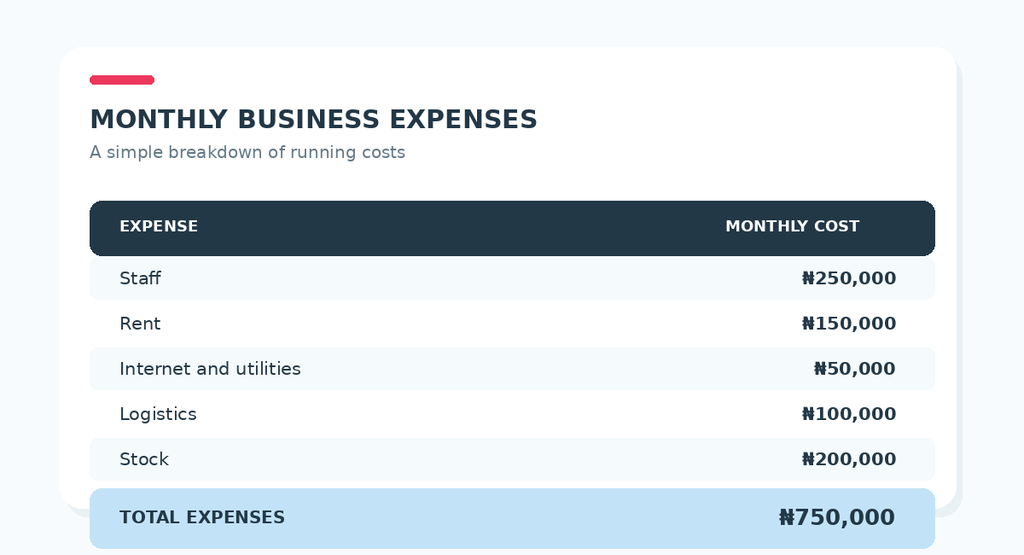
This gives the business a baseline of ₦750,000 in monthly expenses.
If you expect to collect only ₦600,000 during the month, you already know there could be a cash shortfall of ₦150,000 if there is no opening balance or other source of cash available.
Spotting that gap early gives you time to make a decision. You could follow up on outstanding payments, delay a non-essential purchase or adjust your stock orders before a supplier or employee is waiting for payment.
Remember to include expenses that don’t come up every month, such as equipment repairs, insurance renewals or annual fees. These costs can put pressure on your cash flow if you don’t plan for them.
4. Keep Track of Money Customers Owe You
If your customers buy now and pay later, outstanding payments can quickly become a cash-flow problem.
You may have completed a sale and recorded the revenue, but until the customer pays, that money may not be available to cover your expenses.
Keep a simple record of:
- Who owes your business money.
- How much each customer owes.
- When payment is due.
- How long overdue payments have been outstanding.
- When you last followed up.
Set reminders for upcoming payments and follow up promptly when invoices become overdue. Where possible, agree on clear payment terms before completing a sale.
You should also make it easy for customers to pay you.
Kredi Pay supports business payment collection through tools such as payment links and virtual accounts, including notifications when payments are completed. These tools can help businesses monitor incoming payments and keep better track of collections.
If your business receives payments from multiple customers throughout the day, having a clearer view of completed payments can make it easier to maintain accurate records.
5. Build a Simple Cash-Flow Forecast
You don’t need complicated financial software to start forecasting your cash flow. A simple spreadsheet can help you see whether you are likely to have enough money to cover upcoming expenses.
Start with the cash available in your business account. Add the money you realistically expect to collect, then subtract the payments you expect to make.
For example:
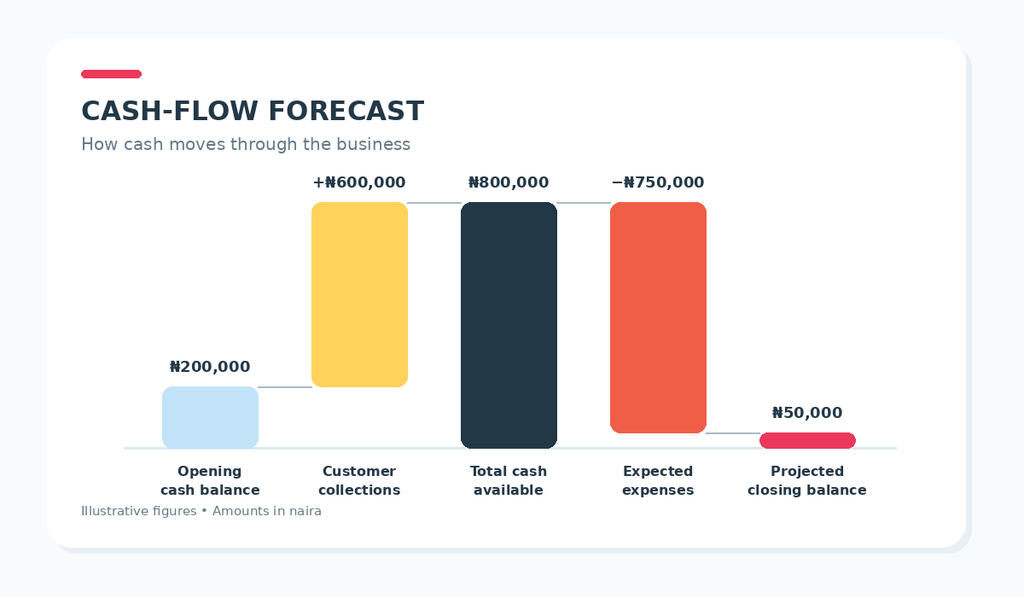
In this example, the business expects to finish the month with ₦50,000.
That is useful information, but it also raises another question: will the business have enough cash on the days its bills are due?
If most customer payments are expected at the end of the month but salaries and supplier bills are due earlier, the business could still face a temporary cash shortage.
To make your forecast more useful, record the expected dates of major payments, not just the monthly totals.
Review your forecast weekly and update it as payments come in or expenses change. If a shortfall is approaching, you can follow up on outstanding invoices, postpone non-essential spending, adjust inventory plans or assess suitable working-capital options.
The earlier you spot a cash-flow gap, the more time you have to respond.
Make Cash Flow Part of Your Business Routine
It’s easy to focus on sales because sales are visible. But a busy month does not always mean your business has enough money available to operate comfortably.
Good cash-flow management helps you understand what money is available, what has already been committed and which payments need your attention.
Start by separating business and personal finances, tracking expenses, following up on outstanding customer payments and reviewing your cash-flow forecast regularly.
Kredi Business provides business financial and payment solutions, including Kredi Pay and BizPay. Depending on your business needs, these tools can support payment collection and other business transaction activities.
Looking to improve how your business collects payments? Explore Kredi Pay to learn more about the available collection options for your business.
The goal isn’t simply to increase sales. It’s to make sure your business has enough cash available to keep operating while those sales turn into actual collections.
For a small business, knowing where your cash is today can be just as important as knowing how much revenue you made this month.
Frequently Asked Questions
What is cash flow management?
Cash flow management is the process of tracking the money coming into and going out of a business. It helps business owners understand how much cash is available, plan for upcoming expenses and identify potential shortfalls.
How can a small business improve cash flow in Nigeria?
Start by separating business and personal finances, tracking expenses, following up on overdue customer payments and preparing a regular cash-flow forecast. You can also review stock purchases and non-essential spending to make sure money is available for important operating expenses.
What is the difference between profit and cash flow?
Profit is what remains after expenses are deducted from revenue over a given period. Cash flow tracks the actual movement of money into and out of the business. A business can be profitable on paper but still struggle to pay its bills if customers have not paid yet.
How often should a small business review its cash flow?
A weekly review is a useful starting point for many small businesses. It helps you track collections, upcoming bills and changes in spending before they create a bigger problem. Businesses with frequent transactions or tight cash balances may need to review their position more often.
How can a business manage late customer payments?
Set clear payment terms, maintain a record of outstanding invoices, send reminders before payment dates and follow up promptly when payments become overdue. Making it convenient for customers to pay can also help. Payment links and virtual accounts may be useful options, depending on your business needs.
How can Kredi Pay help a small business?
Kredi Pay supports business payment collection through tools such as payment links and virtual accounts, with notifications when payments are completed. Businesses can explore its available features to determine whether they suit their collection and payment-tracking needs.
